
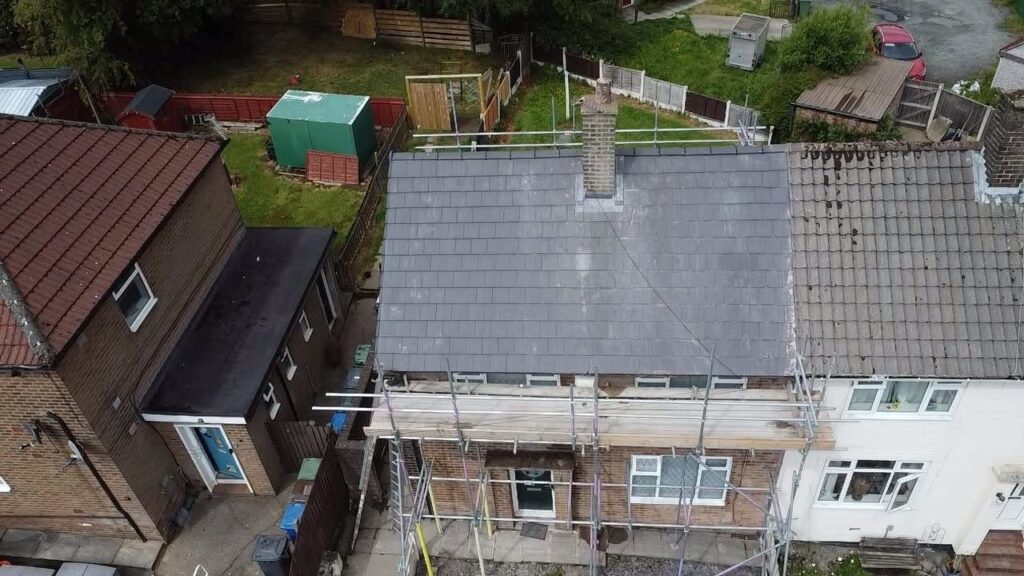
The wind drops some time after 3am. By breakfast there’s a broken slate on the drive, and nobody’s sure which part of the roof it came from.
We get a lot of calls on mornings like that across Preston, Chorley and Leyland. The UK storm naming season starts again every September, and the first proper autumn gale has a habit of finding every loose tile and tired ridge line the summer left behind. Most of what you need to know can be worked out from the ground, before anyone goes near a ladder.
Check from the ground first
Walk all the way round the house in daylight. Take your phone and zoom in, or borrow binoculars if a neighbour has a pair. You’re looking for anything that has changed since yesterday.
Missing tiles and slates show up as a dark gap or a patch of lighter felt in an otherwise even pattern. Slipped ones sit lower than their neighbours. Along the top, the ridge should run in a straight, unbroken line, and a ridge tile that has shifted even an inch is worth reporting because the mortar under it has let go. Then look at the chimney. Lead flashing peeling away from the brickwork, a TV aerial suddenly leaning at an angle and lumps of mortar in the gutter are all signs of wind damage up there.
Finish in the loft if you can get into it safely. Switch the light off and look for daylight coming through, then check the insulation for damp patches and the underside of the felt for drips. A torch helps. Anything wet up there needs dealing with quickly, even if nothing has shown on a ceiling yet.
Don’t climb up to look. Wet tiles after a storm are about as slippery as a roof ever gets, and the gusts often keep coming for a day or two after the worst has passed. Photograph what you can see from the ground and leave the rest to someone with proper access.
The damage storms usually do
Wind attacks a roof at the edges. Tiles along the eaves and verges take the brunt of it, and so does the ridge, where old mortar-bedded ridge tiles can be lifted clean off once the bedding has cracked. On older Preston terraces we regularly find slipped Welsh slates where the nails have rusted through, and a strong gust finishes the job. Flat roofs suffer too. Felt lifts at an unsealed edge, and the wind peels it back a bit further every time it gets underneath.
Then the rain arrives. An inch of it in a few hours will overflow any gutter that’s half full of leaves, and the water backs up under the roof edge where it was never meant to go. A good share of the storm leaks we’re called to start at a blocked gutter. Our guide to guttering, fascias and soffits covers the warning signs.
What counts as storm damage for insurance
Most buildings insurance covers storm damage. Almost no policy covers wear and tear, and that line is where claims get argued over.
Insurers want answers to three questions, and the Financial Ombudsman asks the same ones when a disputed claim reaches them. Were there storm conditions around the date the damage happened? Is the damage the kind a storm typically causes? And were those conditions the main cause, or did the storm simply expose a roof that was already failing? Many insurers treat gusts of around 55mph as the point where bad weather becomes a storm, so it’s worth checking the Met Office records for your area on the day.
That third question is the tricky one. A ridge that blew off because its mortar had been crumbling for ten years can be turned down as wear and tear, even though the wind was the last straw. Evidence decides it. Clear photos taken soon after the storm help, and so does a roofer’s report describing what failed and why. Our drone roof surveys capture every part of the roof without anyone walking on it, which matters when the damage is somewhere you can’t see from the garden.
Your policy will also expect you to stop the damage getting worse. A temporary repair to keep the weather out is normally fine to go ahead with before the insurer has visited, so keep the receipt and the photos. Hold off on the permanent repair until the claim is agreed, unless your insurer tells you otherwise.
When to get a roofer out
If water is coming through a ceiling or tiles are hanging loose over a path, call our emergency roof repair line and we’ll make it safe first. The same goes for a chimney that looks like it has moved. If water is already inside, our guide to what to do when your roof leaks in heavy rain covers the first hour.
Everything else should still be looked at within days. Storms tend to arrive in runs, and a tile that slipped an inch on Tuesday is often gone by the weekend, taking the felt beneath it too. Catching it early keeps it a small roof repair.
Before the next one
September and October are the months to get ahead of it. Clear the gutters once the leaves are down, get slipped tiles refixed, and have someone check the ridge and the chimney flashing while it’s still dry enough to work. Our winter roof guide for Preston homeowners goes through it in more detail.
If you’d like a second pair of eyes after a storm, MKY Roofing covers Preston, Chorley, Leyland and the surrounding towns. Call us on 01257 491 065 or send us a message with a photo of what you’ve found, and we’ll tell you honestly how urgent it is.


